
Long Division II… so, what’s in this thing?
There are four layers of circuit boards to make this module work. The basic outline is this: the Voice/Audio/Power board has the twelve master oscillators on it, along with all the divider chips to provide all the notes across the five octaves. After the notes are generated, they move on to the pulse wave convertor boards, where the waves are either left as square waves or turned into a very narrow negative going pulse. The waves then move on to the diode keying boards, which have inputs on the top and bottom. When a note is played, the signal is sent from the MIDI decoder, and shifted up to +12 volts (from logic level +5 volts), and fed into the bottom of the keying board. It then gates through the corresponding note coming in the top, and is sent to a summed output (the RCA jacks in the picture). This audio signal is then sent back to the Voice/Audio/Power board for mixing, tone control, and volume control, and finally the audio output jack on the front panel. Every single note has its own keying circuit which consists of five diodes, two capacitors, four resistors, and one field effect transistor. Every note also has its own individual pulse wave convertor circuit, consisting of one capacitor, four resistors, one diode, and two field effect transistors. Each board is built with 32 notes available, so you add all that up and you have 384 diodes, 192 capacitors, 512 resistors, and 192 transistors! The Voice/Audio/Power board has 16 ICs and the level shift board has eight, not including the MIDI decoder board itself. When you want complete polyphony done in analog, that’s what it takes.
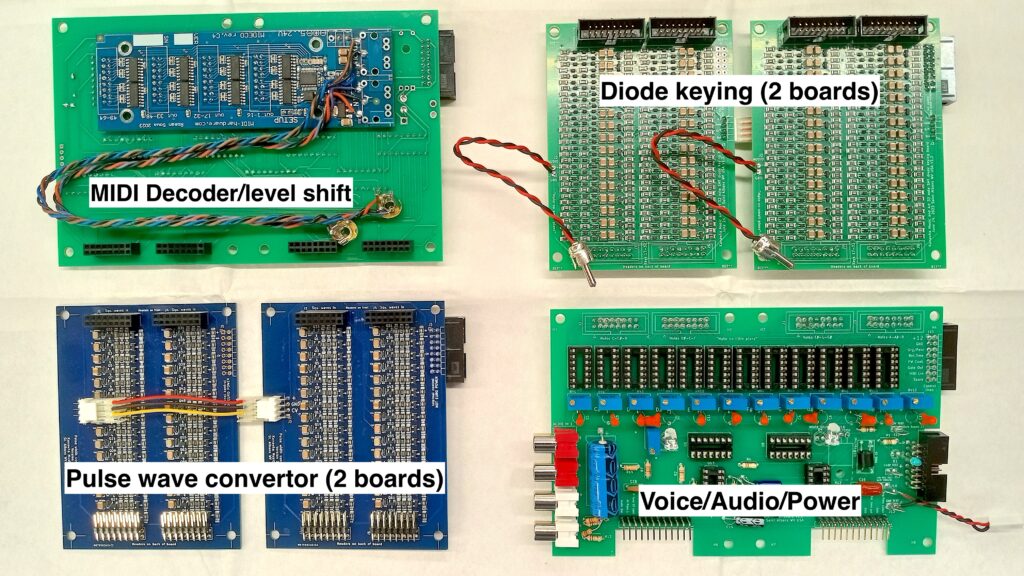
As much stuff is in there, it’s all designed to be serviceable, as much as surface mount technology can be. The front panel is built separately and plugs on to the Voice/Audio/Power board:
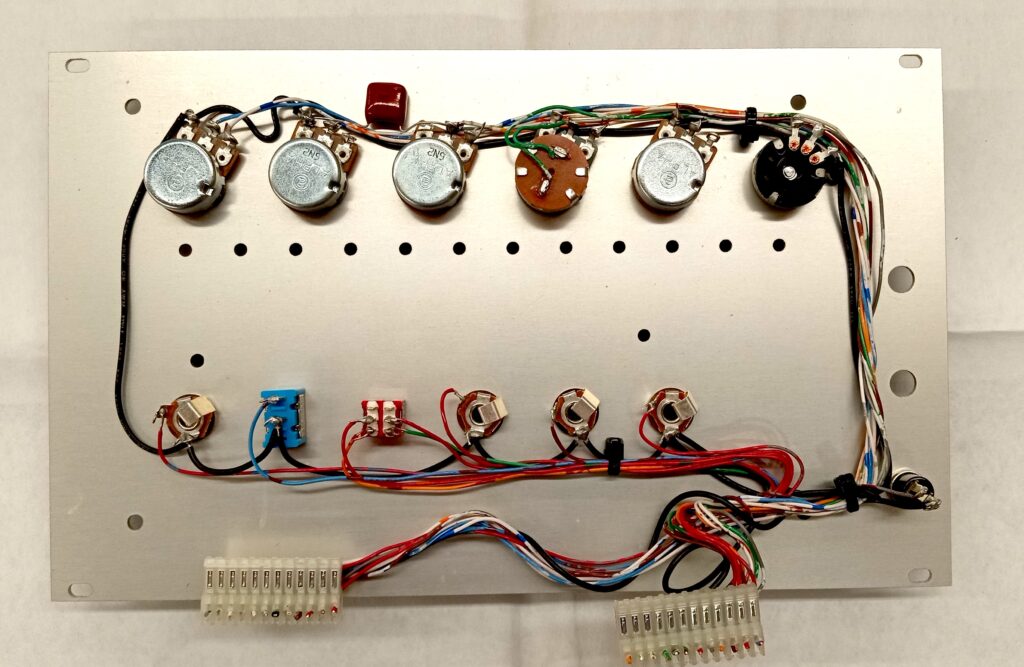
Note that Long Division (original) is very similar but doesn’t have the square/pulse wave boards or Gate Out. It also has more internal wiring which was cleaned up with ribbon cables for easier servicing.